The Work
Every serious landscape photographer eventually comes to Tunnel View.
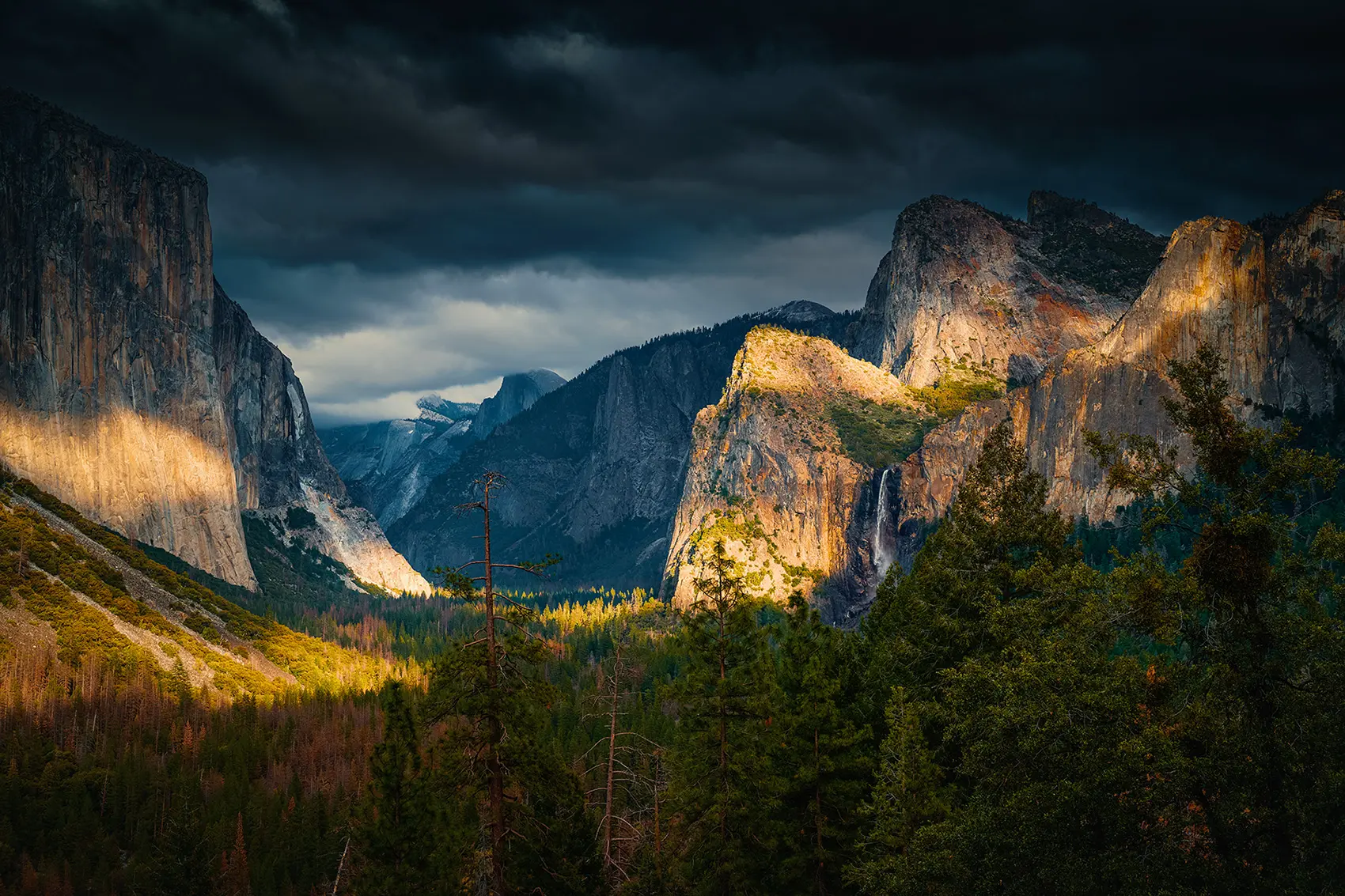
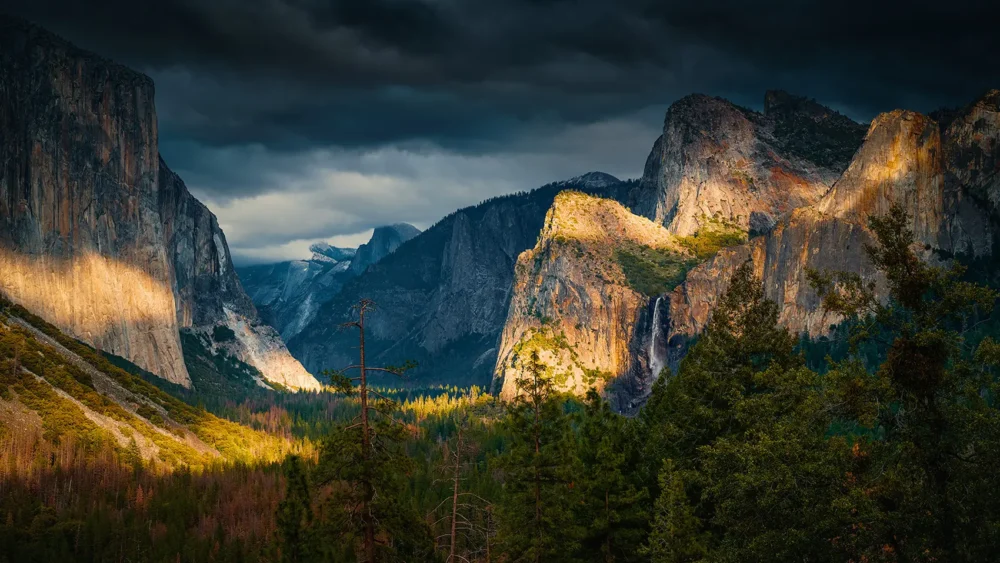
Ansel Adams came here. Hundreds of photographers have come here since. The viewpoint frames El Capitan on the left, Half Dome in the center distance, Bridalveil Fall on the right, and the full sweep of Yosemite Valley below — a composition so complete that the valley itself seems to have arranged the geology for the purpose. The photograph makes itself. The question is what conditions you bring to it.
I was here in February 2018, approximately two hours before sunset, in the aftermath of a passing storm. The cloud deck was breaking from the west — meaning El Capitan’s face was catching direct late-afternoon sun while the valley floor was still under storm shadow. Bridalveil Fall was running at winter volume from the snowmelt. The contrast between the lit granite and the shadowed valley was deeper than any clear-day image can produce; the storm had compressed the dynamic range into a single dramatic interval.
I had about fifteen minutes before the light normalized. I made one frame.
The Location
Tunnel View is a designated overlook at the eastern end of the Wawona Tunnel in Yosemite National Park, California, at elevation 3,967 feet. The overlook faces east-northeast into Yosemite Valley, with El Capitan (7,573 ft) on the left, Bridalveil Fall and Cathedral Rocks on the right, and Half Dome (8,839 ft) visible in the distance. It is one of the most photographed viewpoints in the United States.
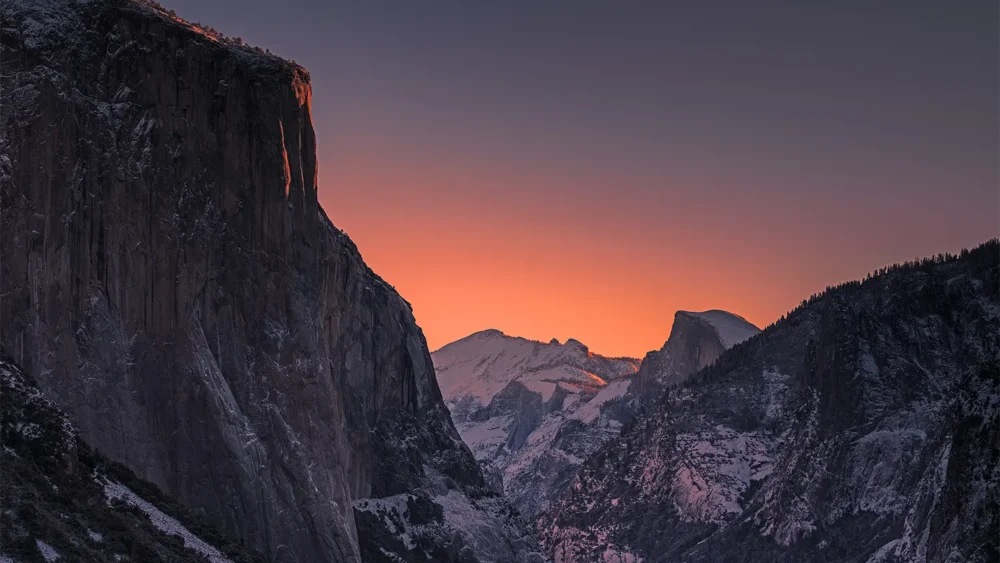
The image was made in February — the valley’s winter season, when visitor numbers are at their annual low, the snowpack feeds the falls at maximum volume, and the afternoon sun comes in at a low arc that catches El Capitan’s south face without flooding the valley floor. Storm-break light — the fifteen-minute window between cloud cover and clear sky — is the rarest and most valued atmospheric condition at this viewpoint.
The Edition
The Capture
System: Nikon D810
Lens: Nikon 14-24mm f/2.8
Technique: Single frame
Date/Time: February 2018, approximately 2 hours before sunset
GPS Region: Tunnel View, Yosemite Valley, Yosemite National Park, California
The Print
Storm-break light at Tunnel View presents one of the steepest dynamic range challenges in landscape photography. The lit face of El Capitan sits near paper-white; the shadowed valley floor sits within two stops of pure black. Between those poles, Bridalveil Fall is a white streak in motion, the cloud mass is a complex of warm grey and pale silver, and the storm-shadowed rock faces are a deep neutral grey. On Hahnemühle Photo Rag 308gsm, all of these zones hold simultaneously — the granite texture is present in the highlights, the shadow detail is present in the valley floor, and Bridalveil’s motion resolves as a softened white without burning.
The Nikon D810’s 36.3MP full-frame sensor captures the valley at a resolution that supports 40×60″ without visible interpolation. At this scale, the image reads as architectural in the upper register — the detail on El Capitan is geological — and painterly in the lower register where the storm shadow softens the valley floor.
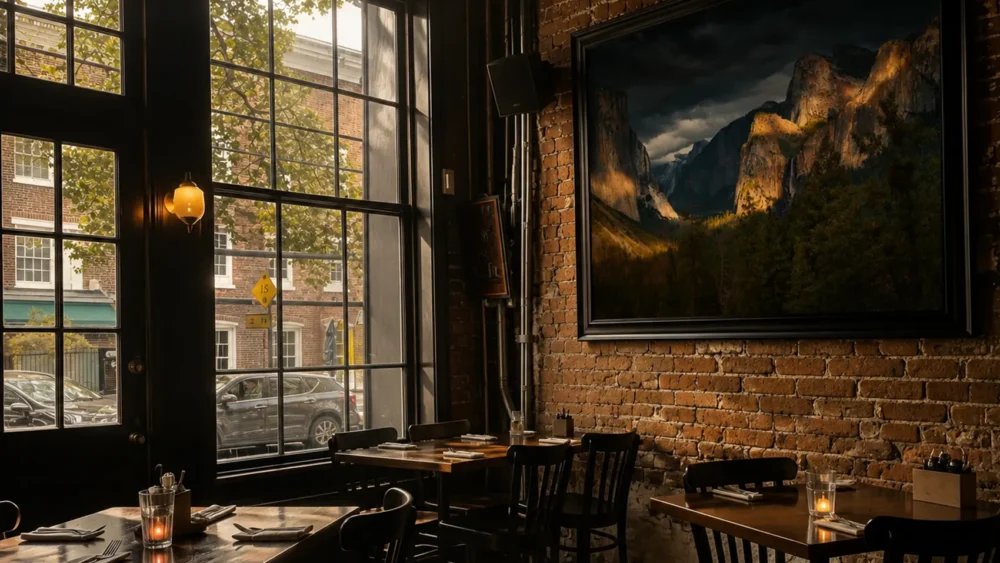
Stormlight has been placed in hospitality settings where the brief was: something that makes guests stop and look. The fifteen-minute storm-break window that produced this image will not repeat. That specificity is visible in the print.