The Work
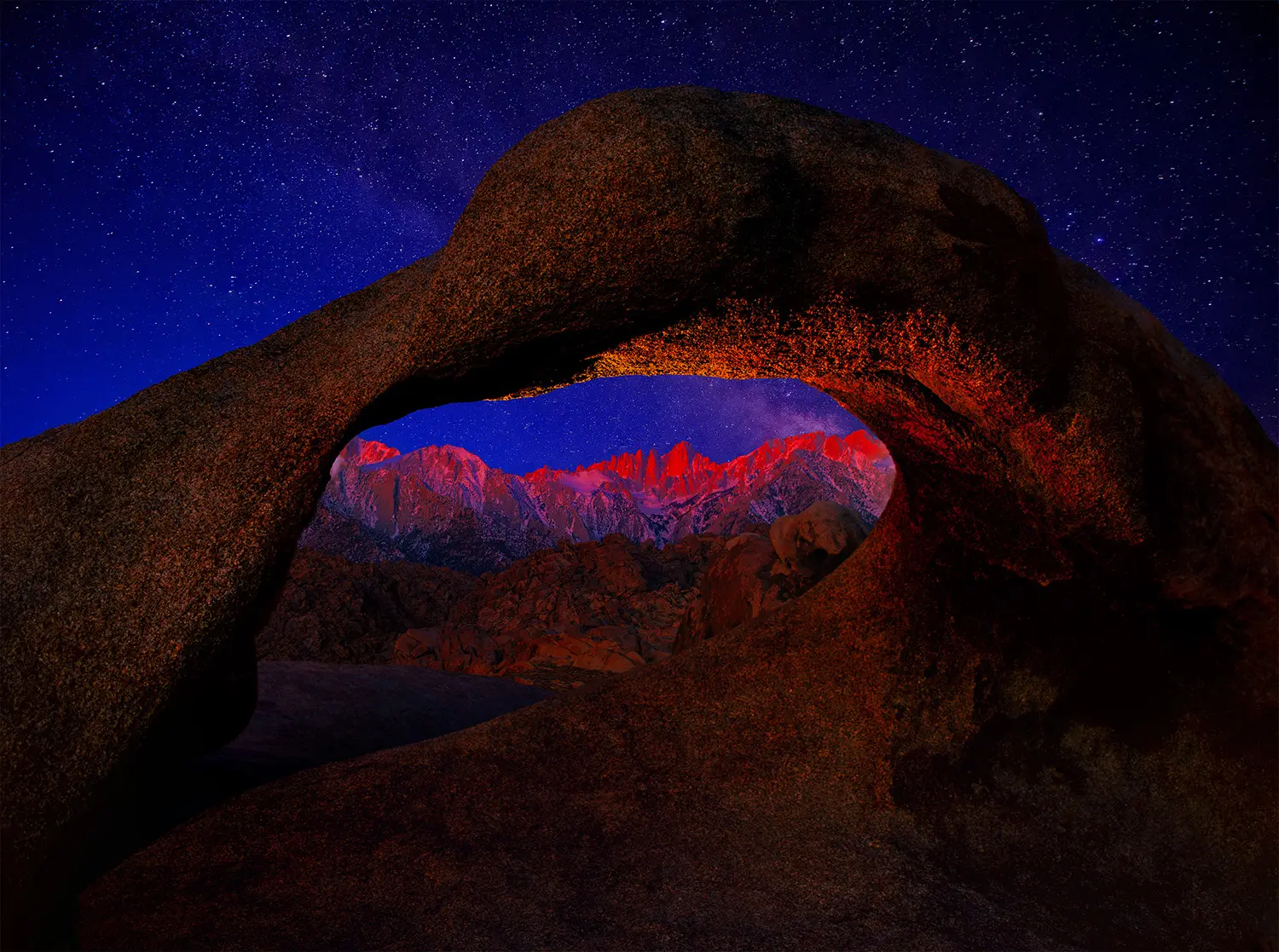
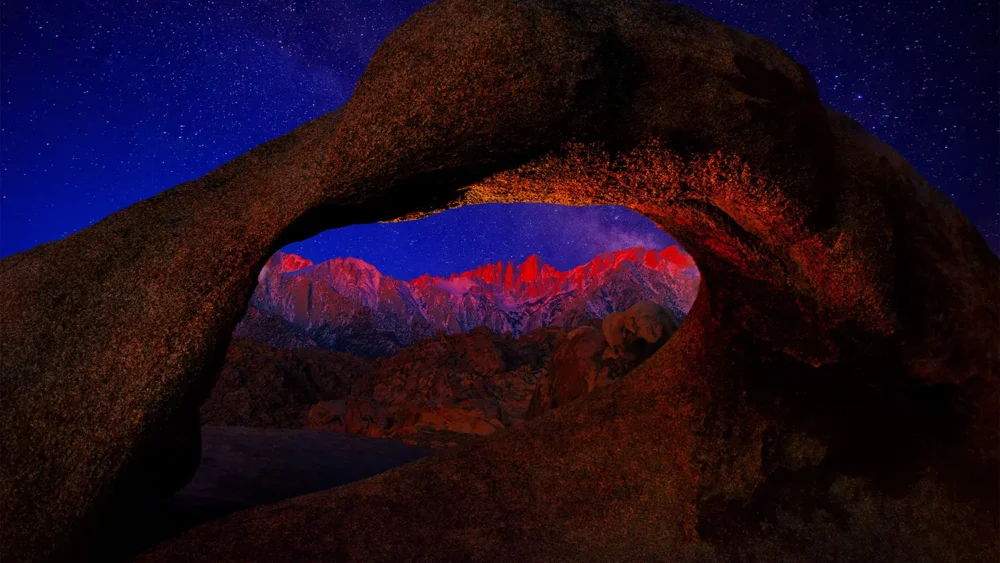
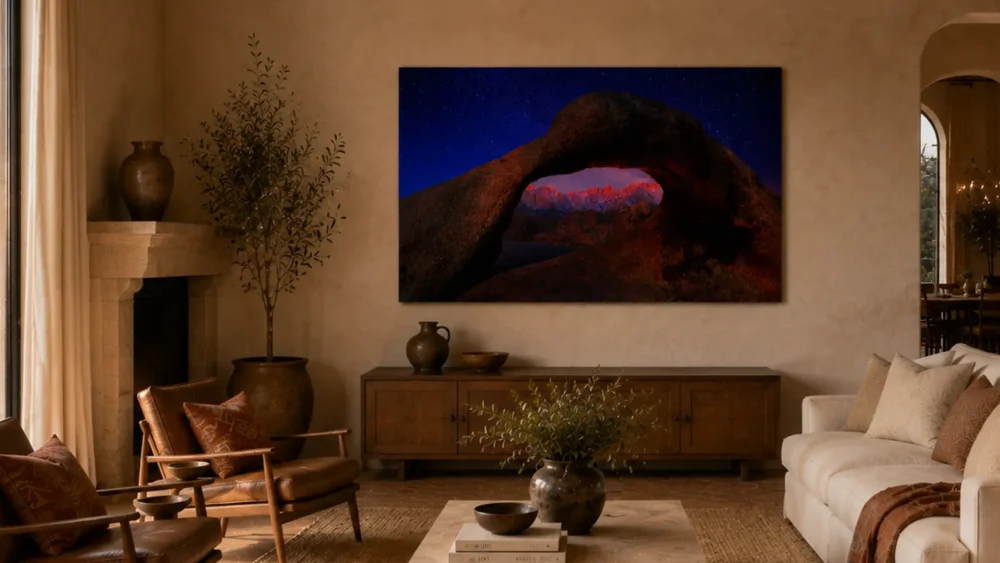
Mobius Arch is a small natural arch in the Alabama Hills, a BLM recreation area at the base of the Sierra Nevada in Owens Valley, California. From one specific position — a matter of feet, not yards — the opening of the arch frames the summit ridge of Mount Whitney, the highest peak in the contiguous United States.
I was there in February 2020, after dark. The Sierra was still holding residual alpenglow on the western faces when I set up, and the stars were becoming visible overhead. I made two frames: one at twilight for the mountain colour and foreground detail through the arch, one deeper into the night for the star field. The final image is a 2-frame composite — a standard astrophotography technique that resolves the fundamental exposure conflict between a lit foreground and a star-dense sky.
The Hasselblad X1D II is not a typical astrophotography camera. Its 50-megapixel medium format sensor was designed for daylight and studio work. Shooting it in the dark, at the ISO required for a clear star field, asks the camera to work at its limit. What it gives back is star detail and tonal latitude that a dedicated night-sky body cannot match at large print sizes.
Starlit Window is the only image in this collection made after dark.
The Location
The Alabama Hills are a range of rounded granite and metamorphic rock hills in Owens Valley, Inyo County, California, at the base of the eastern Sierra Nevada escarpment. The area has served as a film location for over 400 productions since the 1920s — Gunga Din, Django Unchained, Interstellar — drawn by the dramatic rock formations against the Sierra backdrop.
Mobius Arch is a natural arch formed by differential weathering of the granodiorite formation. Its orientation, unique among the Alabama Hills arches, places the Sierra Nevada summit ridge — including Mount Whitney at 14,505 feet — within the arch’s opening when viewed from a specific ground-level position. The arch functions as a natural telephoto frame, concentrating the mountain beyond into a contained visual field.
Mount Whitney is 13 miles from Mobius Arch as the crow flies. On a clear February night, the summit snowpack is visible through the arch with the naked eye.
The Edition
Studio Edition. Edition of 25, hand-signed and numbered. Each acquisition is accompanied by a Certificate of Authenticity with hologram provenance seal. Edition 23 of 25 available. 2 sold.
The Capture
System: Hasselblad X1D-50c II medium format (50MP)
Lens: 35–100mm XCD (focal length at capture — TBC)
Technique: 2-frame composite — twilight exposure for foreground & mountain; night exposure for star field
Date / Time: February 2020, post-sunset into astronomical twilight
GPS Region: Mobius Arch, Alabama Hills Recreation Area, Inyo County, California
The Print
The colour range in this image spans from the warm residual alpenglow on the Sierra peaks through the deep blue-indigo of the night sky to the near-black foreground rock. On Hahnemühle Photo Rag 308gsm, the star field resolves as individual points of light — not grain, not noise, but discrete stars — because the 50MP medium format capture holds enough resolution to separate them at 40×60″. The deep blue of the sky above the arch holds its saturation without shifting to black; the mountain colour holds its warmth without going orange.
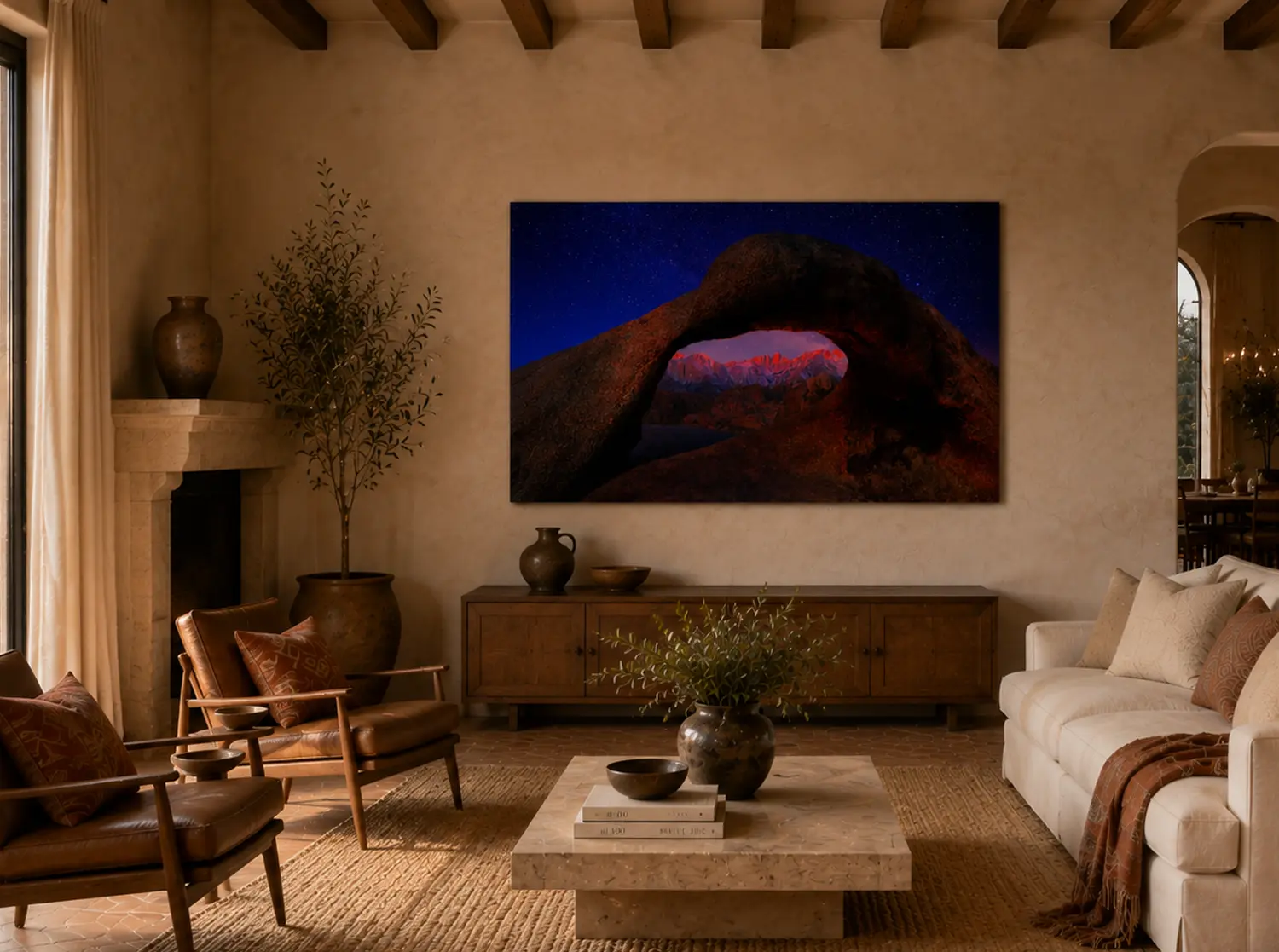
For interior placement: the horizontal composition works well across wide walls. The dark palette — deep blue, near-black — reads best against warm neutral walls (cream, linen, taupe) where the cooler image tones provide contrast. Against a white or cool-grey wall the image can disappear into the wall. Minimum recommended: 30×45″. At 40×60″ the star field and arch detail reward close viewing.