The Work
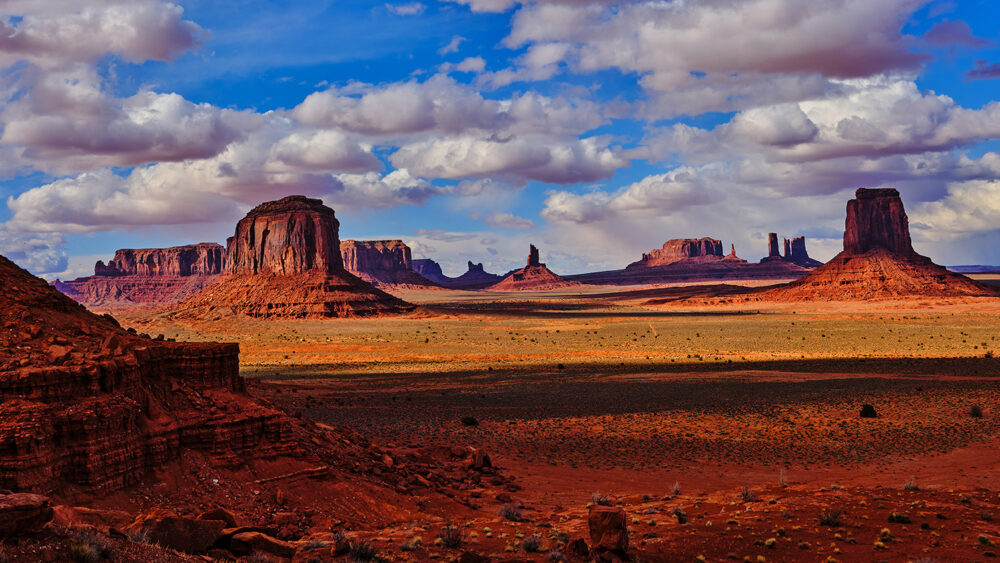
Garden of the Gods doesn’t look like this often. Most of the year, it is red rock under blue sky — stark, hot, familiar. The formations are 300 million years old, Permian-era Lyons sandstone tilted nearly vertical by the same tectonic forces that built the Front Range. Five million people visit each year. Almost all of them see the park in sunshine.
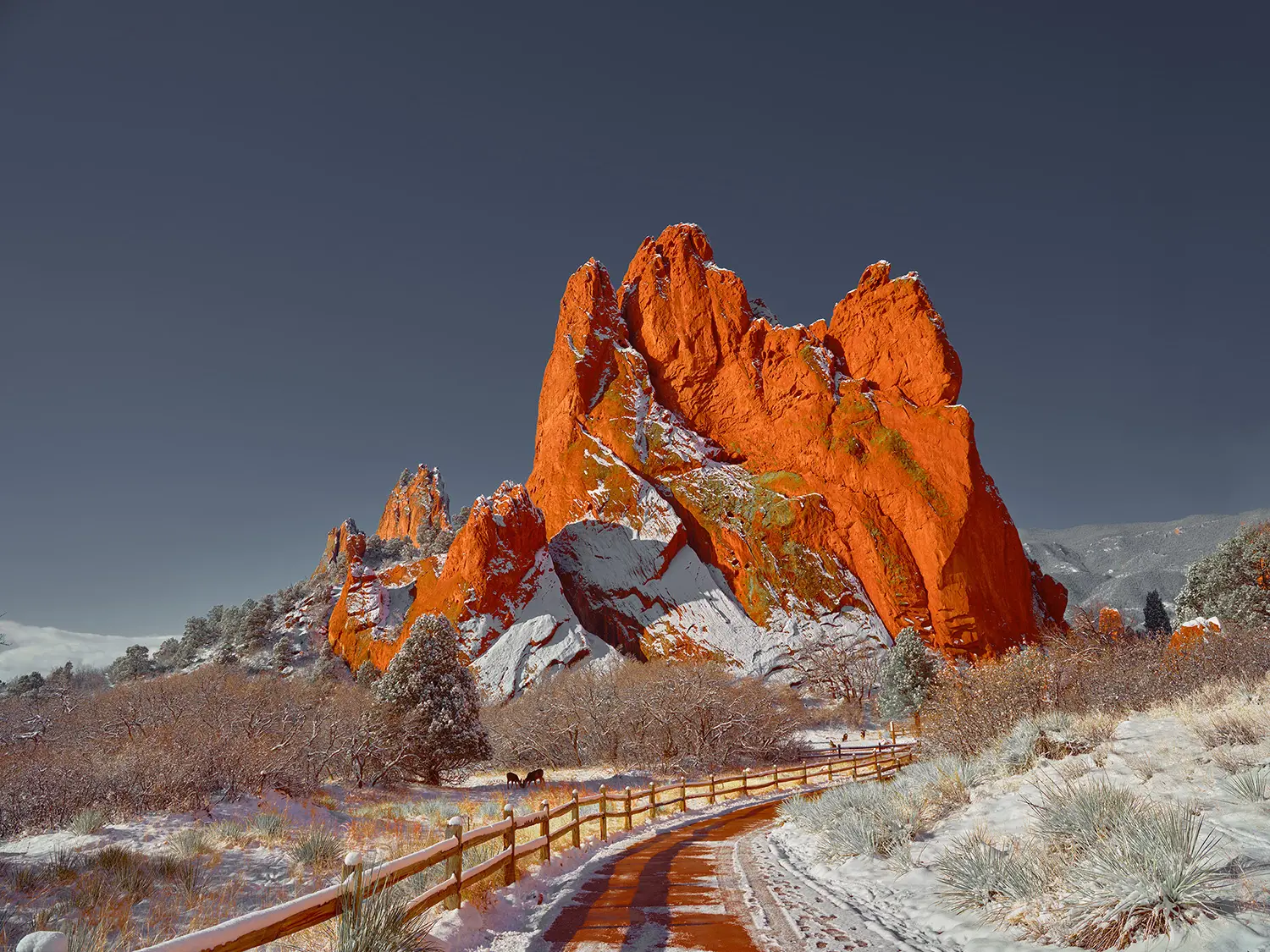
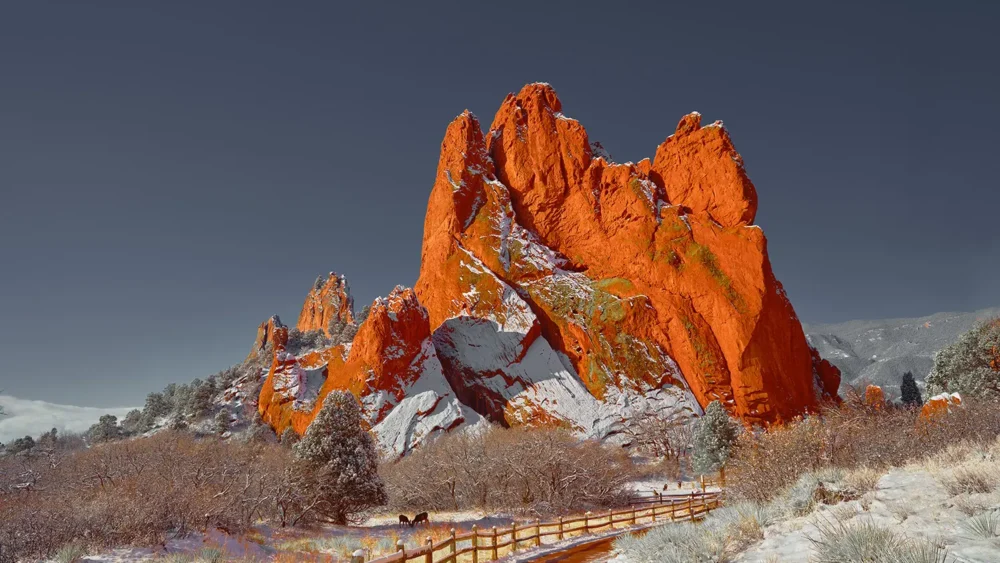
Crimson Sentinels shows what the park looks like when the weather disagrees.
I arrived at sunrise on 04 09.2023, after overnight snowfall. The formations were coated — not buried, but traced — every ledge, every crack, every horizontal surface holding a thin line of white. The red sandstone darkened with moisture, deepening from its usual salmon-pink to a true crimson. And the contrast between crimson rock and white snow, a overcast sky, was the most visually extreme thing I had ever seen in this park.
The long-awaited weather—specifically, overnight snowfall—finally arrived. I wanted to witness the contrast between the pristine white snow and the saturated hues of the red rocks. I headed out in the early morning, when there were almost no visitors around, though the park services were already on hand, clearing snow from the paths and walkways for the visitors who would arrive later. After sunrise, the snow vanished at lightning speed—perhaps within just an hour, it was completely gone. Fortunately, I managed to capture a few shots before that happened. Thank you.
The path in the foreground is deliberate. In the Eureka Dunes body of work, there is no human reference — no trail, no footprint, no scale. Crimson Sentinels is different. The path invites the viewer in. You can imagine walking between these formations, feeling the cold air, hearing the snow compress under your boots. This is not a photograph you look at from a distance. It is a photograph you enter.
The Location
Garden of the Gods is a 1,364-acre public park in Colorado Springs, Colorado, at the foot of Pikes Peak and the Front Range of the Rocky Mountains. The park’s red sandstone formations — tilted vertical fins, spires, and arches — were deposited approximately 300 million years ago during the Permian Period and uplifted to their current position during the Laramide orogeny, the same mountain-building event that created the Rockies.
The red colour comes from iron oxide in the Lyons sandstone, and it intensifies when wet — which is why the crimson in this image is deeper and richer than the rock appears in dry conditions.
Snow at Garden of the Gods is uncommon but not rare — Colorado Springs receives approximately 40 inches of snowfall per year, often in brief, intense events that coat the landscape and then melt within hours. The window for capturing this juxtaposition — heavy snow on warm-toned rock — is measured in hours, not days.
The Edition
Crimson Sentinels is released as a strictly limited edition of 15 prints worldwide, offered in three sizes. Once the 15th print is sold, the image is permanently retired.
Every print is hand-signed and numbered on the recto by the artist, accompanied by a serialized Certificate of Authenticity with dual-hologram provenance, personally inspected before leaving the studio, and registered in the Light & Shadows edition archive.
Current edition status: Edition 14 of 15 available. 1 sold.
The Capture
System: Fujifilm GFX
Lens: 32-64mm
Date/Time:04.2023 Sunrise
GPS Region: Garden of the Gods, Colorado Springs, El Paso County, Colorado
The Print
Produced on Hahnemühle Photo Rag 308gsm — 100% cotton, acid-free, museum-grade — using archival carbon pigments rated for over 100 years of colour stability.
Crimson Sentinels is the most chromatically complex image in the collection. It contains three distinct colour zones: the deep crimson of wet sandstone, the pure white of fresh snow, and the neutral grey-blue of winter sky. The cotton rag substrate holds all three without cross-contamination — the crimson stays warm, the snow stays neutral (no pink bleed from adjacent red), and the sky holds its cool tone without shifting toward green. This colour isolation is where the Hahnemühle earns its premium: on lesser substrates, the red bleeds into the white at the boundary, and the image loses the sharp mineral edge of stone meeting snow.
The warm base tone of the Hahnemühle Photo Rag subtly enhances the crimson without tinting the snow — the paper’s natural cream-white reads as “warm neutral” rather than “cold white,” which keeps the overall image feeling grounded and organic rather than clinical.
Framing in hand-finished hardwood with museum glass. The artist recommends natural walnut — a warm wood that bridges the crimson rock and the white snow, or dark charcoal for a more dramatic presentation that lets the red dominate.
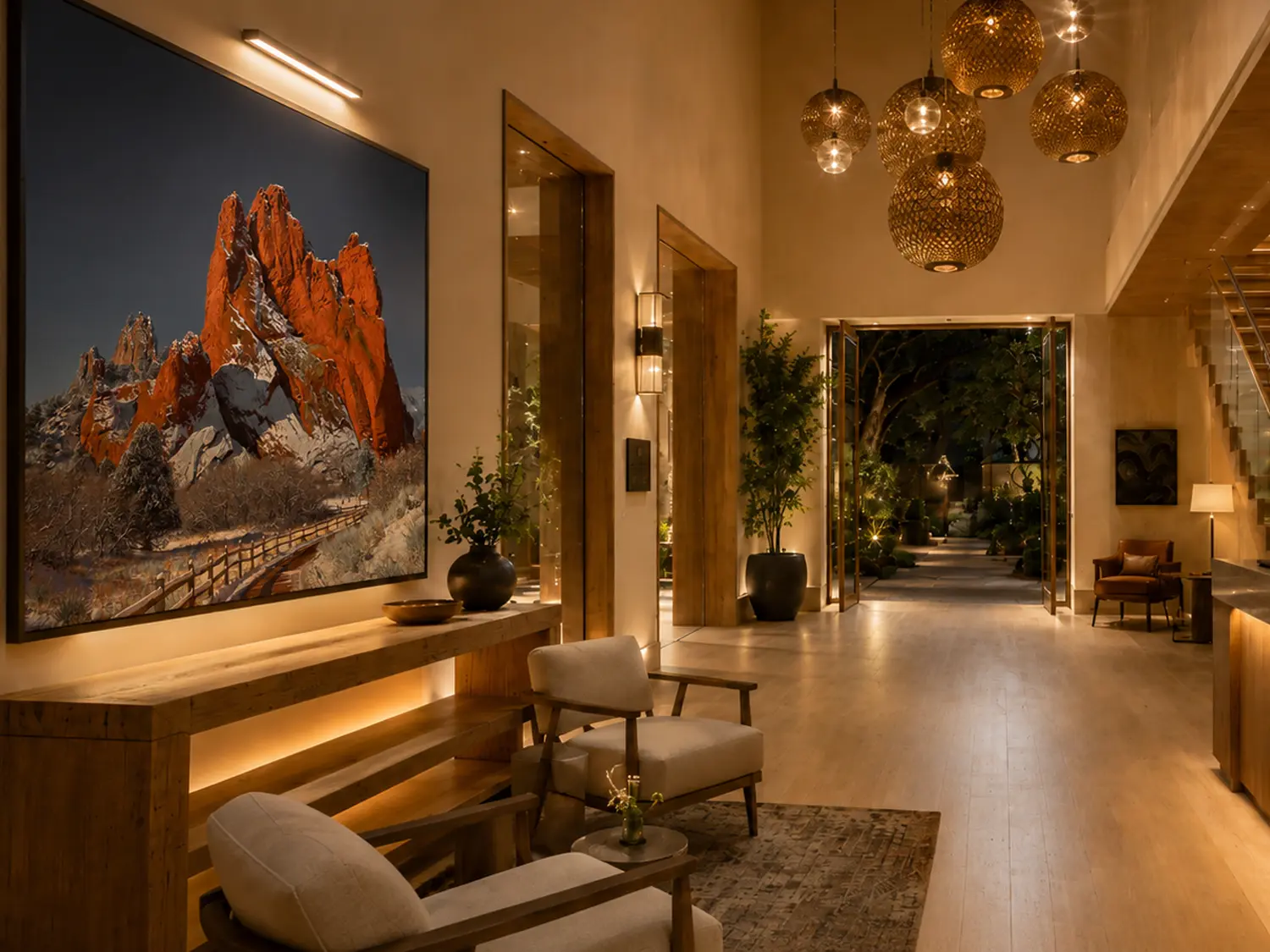
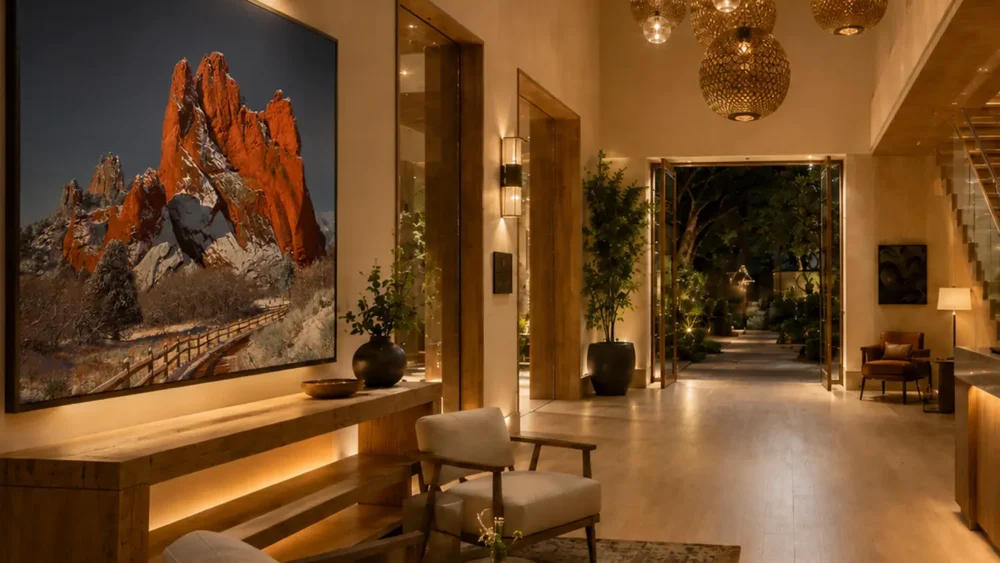
Crimson Sentinels at approximately 60×80″, framed in matte black with picture-light illumination, in the reception seating area of a Colorado luxury boutique hotel. Arriving guests see the region they have travelled to visit — Garden of the Gods in winter — before they complete check-in. The image validates the property’s sense of place, and the property in turn validates the acquisition.