The Work
In the stillness before sunrise, the mountains of Death Valley ignited — not with fire, but with light.
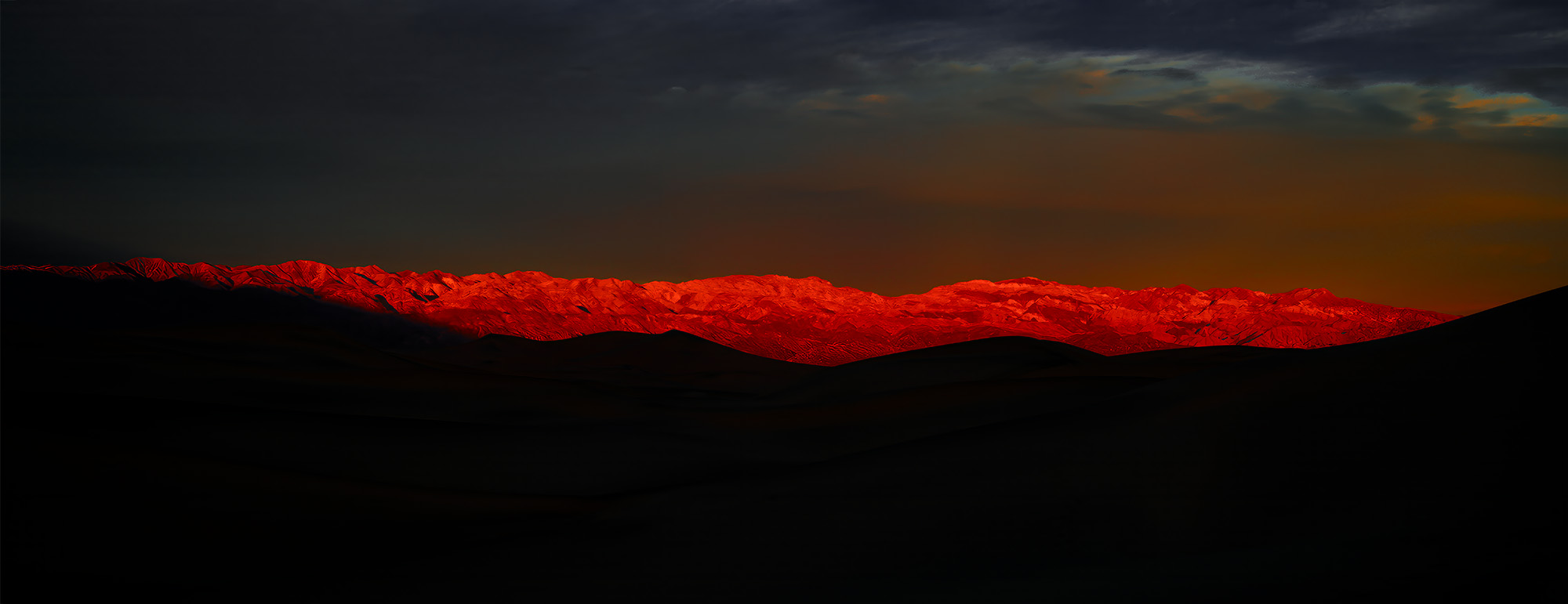
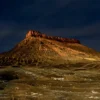
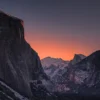
A crimson band appeared along the crest of the Panamint Range, drawn by the first direct sun clearing the Funeral Mountains to the east. Below, the Mesquite Flat Sand Dunes and the valley floor remained in deep blue shadow. For approximately 6 minutes, the only colour in the landscape was that band — a single horizontal incision of red across miles of darkness.
Crimson Divide is named for the line that separates the two worlds in this image: the lit ridge above, the unlit valley below. It is not a gradual transition. It is a divide — sharp, crimson, absolute. On one side, the mountain is awake. On the other, the desert is still asleep.
The classic viewpoint for this composition is from Highway 190. The temperature this morning was around 30 degrees Fahrenheit.
This is the only image in the collection that captures alpenglow — the phenomenon of pre-direct or first-direct sunlight illuminating a mountain summit while the valley below remains in shadow. The colour is not enhanced. Alpenglow on the Panamint Range is genuinely crimson — the result of long-wavelength red light surviving its passage through the atmosphere at the extreme low angle of dawn.
The Location
The Panamint Range forms the western wall of Death Valley, rising over 11,000 feet from Badwater Basin (the lowest point in North America) to Telescope Peak. The range runs roughly north-south for over 60 miles, and at sunrise, the eastern face catches the first light while the valley floor below — one of the deepest enclosed basins on the continent — remains in shadow.
The foreground of Crimson Divide includes the Mesquite Flat Sand Dunes, the most accessible dune field in Death Valley and a dramatically different formation from the Eureka Dunes that dominate the rest of the collection. Where Eureka Dunes are tall, isolated, and rarely visited, Mesquite Flat is broad, low, and surrounded by the Panamint and Grapevine ranges on all sides. The two dune fields are separated by over 50 miles of desert.
02.2022 Winter sunrise at Death Valley produces the most dramatic alpenglow because the sun rises at the most acute angle.
The Edition
Crimson Divide is released as a strictly limited edition of 15 prints worldwide, offered in two sizes. Once the 15th print is sold, the image is permanently retired.
Every print is hand-signed and numbered on the recto by the artist, accompanied by a serialized Certificate of Authenticity with dual-hologram provenance, personally inspected before leaving the studio, and registered in the Light & Shadows edition archive.
Current edition status: Edition 14 of 15 available. 1sold.
The Capture
System:Fujifilm GFX
Lens:45-100mm
Technique: 3 frame panoramic stitch — total resolution approximately 500 megapixels
Date/Time:02.2022 —6 minutes before sunrise]
Viewpoint: Highway 190
GPS Region: Death Valley National Park, Inyo County, California
The Print
Produced on Hahnemühle Photo Rag 308gsm — 100% cotton, acid-free, museum-grade — using archival carbon pigments rated for over 100 years of colour stability.
The crimson in this image occupies a narrow, intense band of the visible spectrum — deep red verging on magenta at the mountain’s edge, cooling to blue-black in the shadow below. This gradient is the most chromatically saturated passage in the entire collection, and it is where the Hahnemühle substrate earns its value most visibly. The cotton rag holds saturated reds without the bronzing or metamerism that can occur on glossy or metallic surfaces — the crimson reads as crimson under any light source, from warm incandescent to cool daylight. On metallic substrates, the same red shifts toward orange under warm light and toward purple under cool light. The cotton rag is colour-stable.
The ultra-wide panoramic format (approximately [2.5:1 / 2.6:1] ratio) means this print is dramatically horizontal. At 30×60″, the crimson band stretches five feet across the wall — a scale at which the colour transition from red to black becomes physically immersive. The eye doesn’t read it; the eye travels it.
Framing in hand-finished hardwood with museum glass. The artist recommends natural walnut or dark oak — a warm frame tone that bridges the crimson of the image and the warmth of the wall.