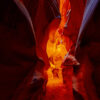
The Work
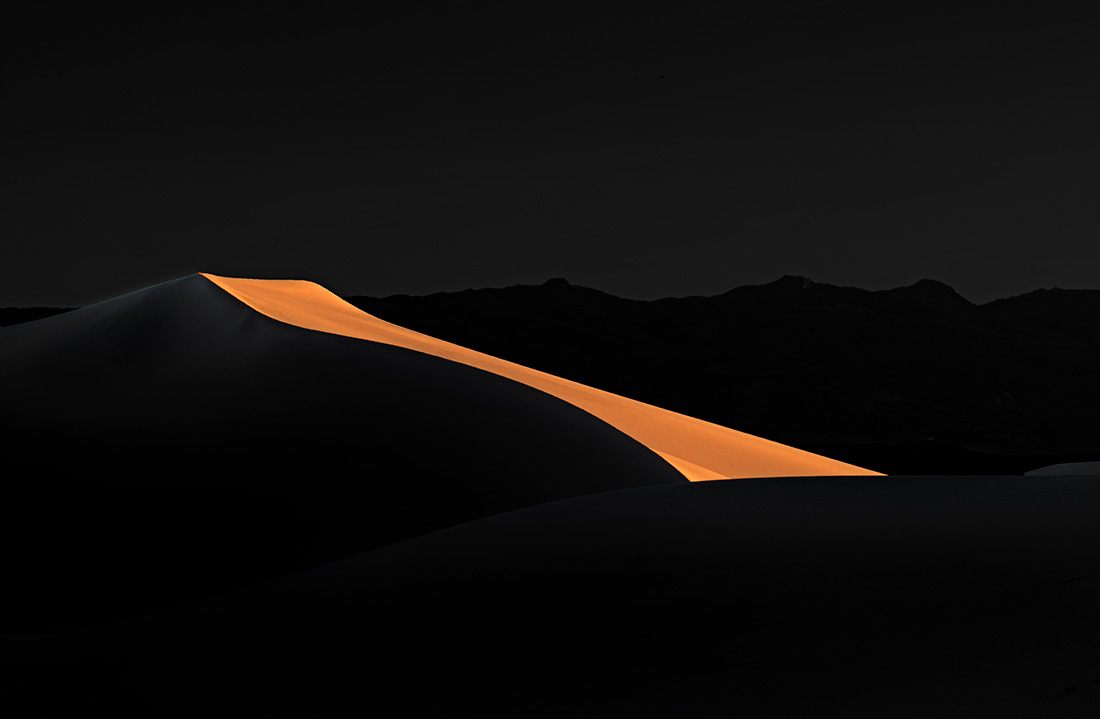
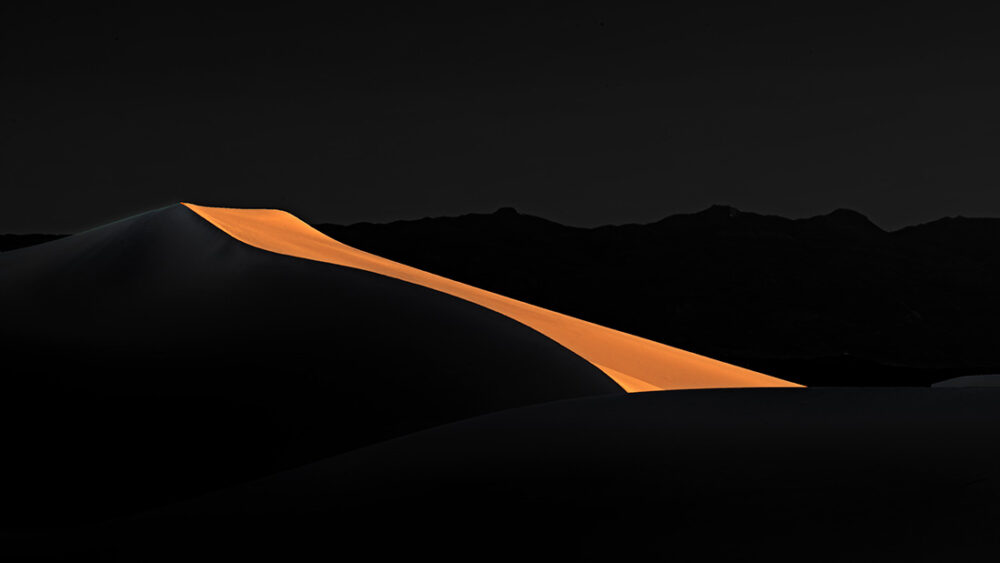
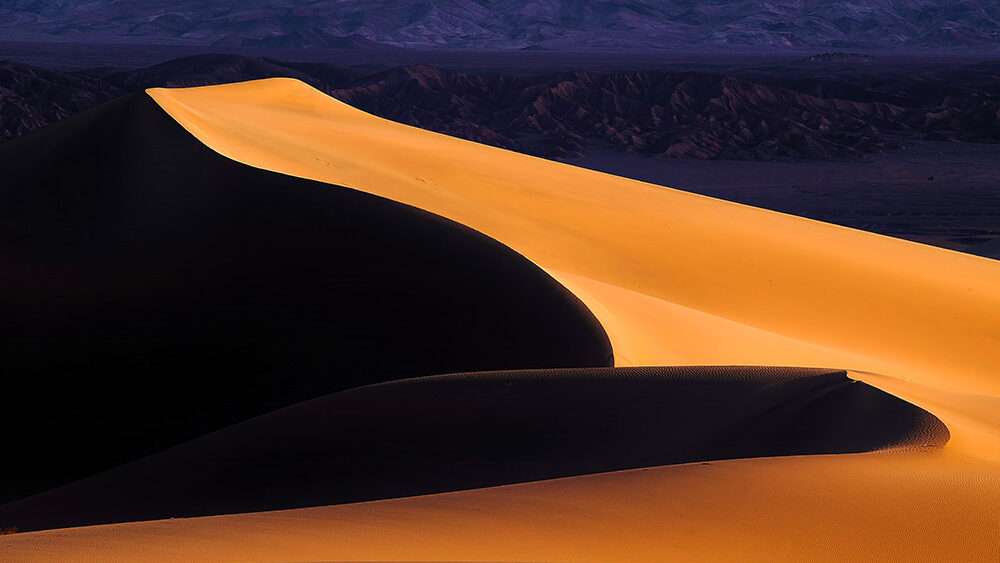
I began my day at 6:00 AM; sunrise was at 6:52. By setting out for the dunes so early, I wanted to be the one waiting for the light—I wanted to see the rays touch the dune crests, to have the privilege of witnessing that extraordinary moment. That day, the sky was clear and cloudless; the light promised to be sharp, grazing the dune ridges and creating magnificent imagery. The morning was quiet; the wind—it seemed—had stayed behind, held back by the mountain range. The silence that prevails in this place is unimaginable. I love this place; Eureka Dunes belongs entirely to me—it is truly a marvelous feeling. I found my spot—the exact point where the sun was destined to touch the dunes first—and set up my camera to be ready for the moment. Fifteen minutes after sunrise, the sun illuminated the first dune—specifically, that thin line of the crest. It was such a quiet line of light, lasting perhaps barely a minute—yet long enough for me to capture four images which, when combined, formed “The Line of Silence.” It was an exquisite moment—precisely the reason I had driven for two days. A true miracle. It is for moments like these that I grab my camera and traverse Eureka Dunes—this time for four days—so that, on the fifth day, I might bear witness to something like this.Unforgettable.Thank you!
THE WORK IN CONTEXT
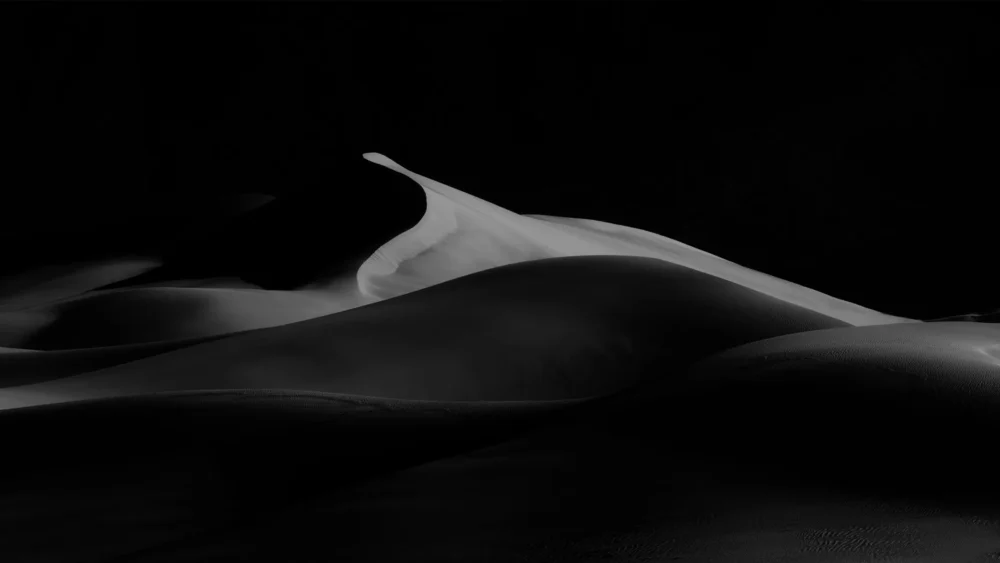
Silent Line belongs to a body of work made at the Eureka Dunes across 7 expeditions. It shares a visual language with two companion pieces- Shadowline (which isolates the same ridgeline against deep black) and Silent Crest (which renders it as a panoramic sweep). Where Shadowline is graphic and Silent Crest is architectural, Silent Line is meditative. It asks for patience, offering depth not through complexity, but through stillness.
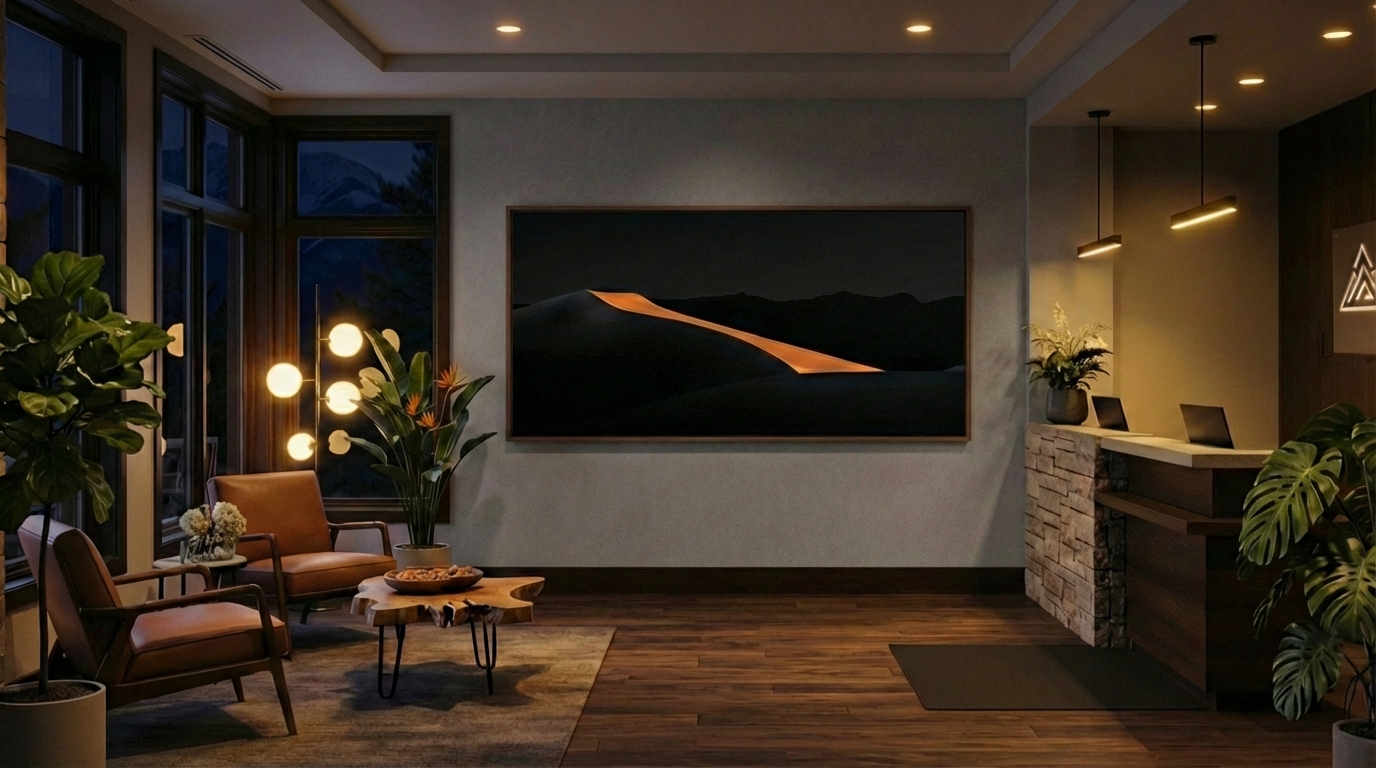
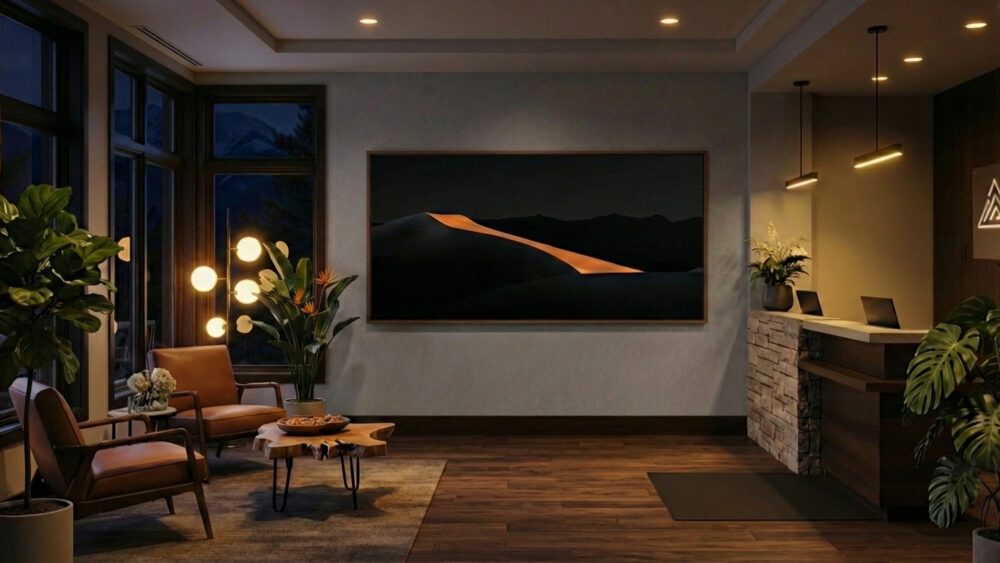
Of the three, this is the smallest in scale but the most intimate in register. It is the image I would hang in a room where I read.
The Location
Eureka Dunes occupy a narrow corridor in the remote northern reaches of Death Valley National Park, rising nearly 700 feet above the valley floor- the tallest dune system in California. The field receives very few visitors. At dawn, the low-angle light catches only the uppermost crest, leaving the dune face in deep shadow. The effect- a bright line suspended in darkness- lasts for 1 minute before the sun climbs high enough to illuminate the full slope.
Silent Line was captured on 02.2022 at approximately 7.05am. The Hasselblad was set at 300mm to compress the ridgeline and isolate the gesture from its surroundings.
The Edition
Silent Line is released as a strictly limited edition of 15 prints worldwide, offered in three sizes. Once the 15th print is sold, the image is permanently retired.
Every print is:
• Hand-signed and numbered on the recto by the artist
• Accompanied by a serialized Certificate of Authenticity with dual-hologram provenance
• Personally inspected before leaving the studio
• Registered in the Light & Shadows edition archive
Current edition status: Edition 14 of 15 available. 1 sold.
The Capture
System: Hasselblad medium format
Lens: 300mm
Date Time:02.2022. 15 minutes after sunrise
GPS Region: Eureka Valley, Inyo County, California
The Print
Produced on Hahnemühle Photo Rag 308gsm — 100% cotton, acid-free, museum-grade — using archival carbon pigments rated for over 100 years of stability.
The tonal challenge in Silent Line is the transition zone — the narrow band where the lit ridge fades into shadow. In a lesser substrate, this gradient steps or bands. On the Hahnemühle cotton rag, the transition is continuous and imperceptible, holding the eye on the luminous edge without a visible break. This is the detail that separates a fine art print from a reproduction.
Framing in hand-finished hardwood with museum glass is available on request. The artist recommends matte black or blackened ash — a quiet frame that doesn’t compete with the image’s own restraint.